
What is a VPN?

A VPN changes how your traffic leaves your device. It hides your IP address, encrypts your connections, and introduces separation between you and the networks you use. This page explains what that actually means in practice — what a VPN protects against, what it does not, and how PoodleVPN is designed around those realities.

How PoodleVPN routes and encrypts traffic

Your IP address identifies you

Every device connected to the internet uses an IP address assigned by a network provider. This address enables connectivity, but it also acts as a persistent identifier. Over time, it can be used to correlate activity, build profiles, and associate behavior with a physical location or household.

When you browse without a VPN, your IP address is visible to websites, services, and intermediaries by default. Even without logging into an account, repeated connections from the same address make long-term correlation trivial.

A VPN replaces your public IP with one controlled by the VPN provider, breaking the direct link between your device and the destinations you access.

Your ISP can observe traffic

Without encryption, internet service providers can see where traffic is sent, when connections are made, and how much data is transferred. Even when content is encrypted at the application level, metadata such as timing, frequency, and destination IPs often remains visible.

This metadata is frequently more revealing than content itself. It allows observers to infer habits, routines, interests, and relationships without needing to inspect payloads.

A VPN adds separation

A VPN encrypts traffic between your device and a remote server operated by the VPN provider. From the perspective of your ISP or local network, all traffic appears as encrypted data flowing to a single destination.

This separation prevents local observers from seeing individual destinations and breaks simple traffic inspection. Websites you connect to see the VPN’s exit address instead of yours.

Importantly, this does not eliminate trust — it shifts it. You are no longer exposing traffic to every network in between, but you must trust the VPN operator’s architecture and policies.

Access and location can change

Because traffic exits from the VPN server’s location, a VPN can bypass certain network restrictions and restore access to services that would otherwise be blocked or filtered.

This is not about pretending to be someone else. It is about removing network-level controls imposed by intermediaries and allowing traffic to flow without geographic discrimination.

What a VPN does not protect against

A VPN does not make you anonymous. Logging into accounts, browser fingerprinting, cookies, device identifiers, and behavioral patterns still exist regardless of where traffic exits.

A VPN also cannot protect against malicious software on your device or unsafe application behavior. Privacy is cumulative — operating systems, browsers, DNS handling, and usage habits all matter.

How PoodleVPN approaches privacy

PoodleVPN is intentionally minimal by design. There are no accounts, no analytics, and no traffic logs. Keys are generated locally and are not tied to identity.

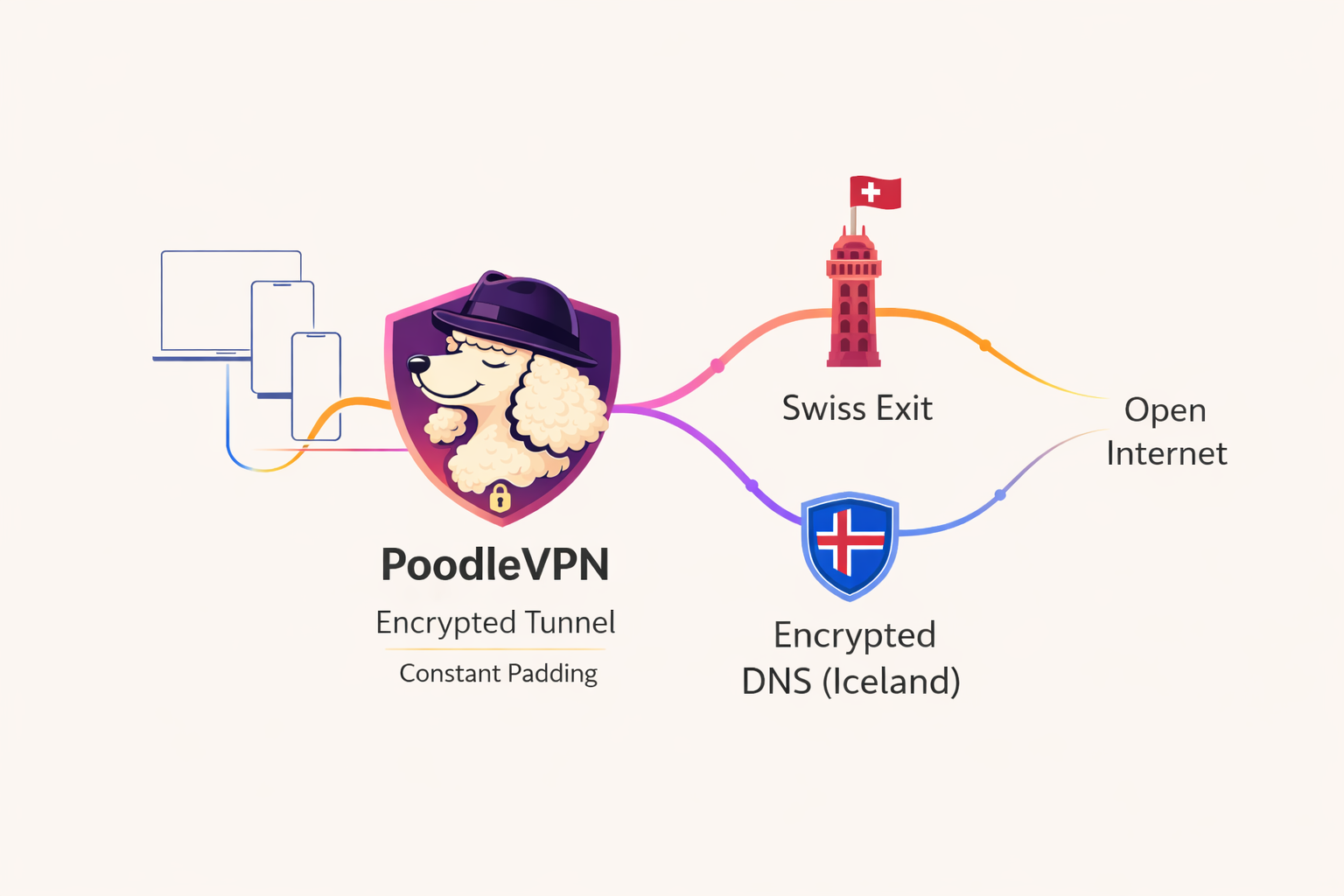
Traffic exits through Swiss bare-metal infrastructure under direct control, while DNS resolution is handled separately through an encrypted tunnel to Iceland. This reduces concentration of metadata in any single jurisdiction.

Flatline: reducing traffic fingerprinting

Even when traffic is encrypted, patterns such as bursts, pauses, and transfer size can be analyzed. Flatline is PoodleVPN’s optional constant-rate padding mode, designed to reduce burst-based fingerprinting without inspecting content.

By normalizing outbound traffic flow, Flatline makes simple traffic analysis less reliable while preserving end-to-end encryption.